How to Make RDF From Textile Waste?
Textile Waste Suitability as RDF Raw Material
Textile waste, comprising fibers, threads, and synthetic blends, has emerged as a viable RDF raw material due to its high calorific value and abundance. Polyester-based textiles, for instance, offer energy values ranging from 22 to 25 MJ/kg, comparable to low-grade coal. Cotton waste also exhibits favorable combustion characteristics, yielding 17–19 MJ/kg on average.

Raw Materials of Textile Waste Pellets
In RDF production, textile waste contributes to fuel diversity, especially in sectors like cement kilns and industrial boilers. Its light weight and relatively low moisture content (typically under 10%) make it suitable for co-processing.
However, storage and transport require consideration. Textile waste’s flammability and compressibility necessitate safe handling: densification into textile waste pellets improves both transport efficiency and fire safety.
Unlock efficiency in alternative fuel strategies: Connect with our RDF engineering consultants today to explore tailored textile pellet solutions.

Key Technical Parameters in Fiber Waste Pelletizing Process
Pre-Processing Essentials
Textile waste must undergo shredding to reduce fiber length below 30 mm, and drying to achieve a moisture content under 12%. Advanced rotary dryers can handle 1.5–2.5 tons/hour while maintaining consistent moisture control.
Compression & Binder Usage
Effective densification is key to producing stable RDF pellets. A bulk density target of 550–650 kg/m³ ensures efficient transport and combustion. Polypropylene or starch-based binders (1–3% by weight) improve cohesion without compromising combustion characteristics.
Temperature & Pressure Settings
Pelletizing requires precision: temperatures should remain between 80°C and 120°C to prevent fiber degradation, while die pressures ranging from 150°C to 250 bar ensure uniformity. Pellet mills with variable frequency drives enable dynamic adjustment during feedstock fluctuations.
Fiber Characteristics and RDF Pellet Quality
The origin of the textile waste, whether industrial offcuts or post-consumer fabric, affects pellet quality. Blended fabrics may need more binder due to variable fiber structure. Processing throughput typically ranges from 800 to 1,200 kg/h per pelletizing line, depending on fiber mix.
Key Equipment Considerations for RDF Production Plant
| Parameter | Recommended Specification |
|---|---|
| Pre-shredder Capacity | 2-3 t/h |
| Dryer Efficiency | <12% final moisture |
| Pelletizer Die Pressure | 150–250 bar |
| Pellet Size | 6-10 mm |
| Bulk Density | 550-C650 kg/m³ |
- Pre-Shredding Efficiency: Ensure consistent fiber length under 30 mm for optimal pellet formation.
- Binder Integration Strategy: Use starch or polymer additives for improved cohesion and minimal ash increase.
- Thermal Regulation: Maintain pelletizing temperature between 80°C and 120°C to balance processing speed and fiber integrity.
- Output Consistency: Monitor real-time pellet shape and density via inline sensors.
- Energy Input Monitoring: Keep total energy usage under 150 kWh/ton for cost-effectiveness.
Fine-tuning these parameters enables efficient conversion of textile waste into fuel-ready pellets compatible with RDF standards.

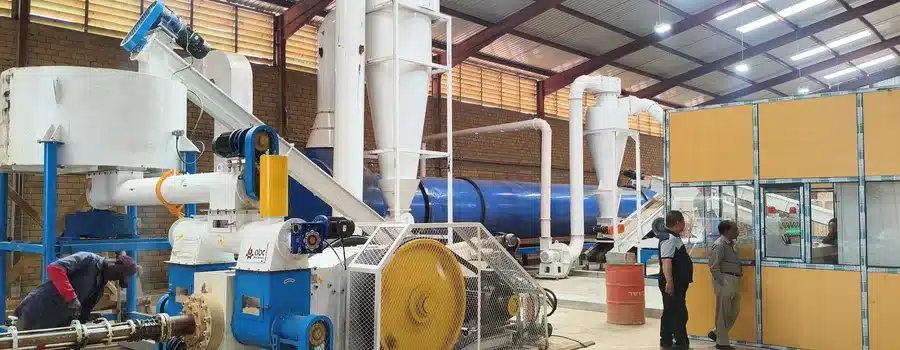
Advanced Textile Residue Pellet Processing Facility
Get Your Customized RDF Pelletizing Process Blueprint —— Contact Our Experts Now.
Strategies to Enhance Pellet Combustion Efficiency
Uniform combustion of textile waste pellets is influenced by three critical factors: ash content, burnout rate, and thermal consistency. Fiber-based RDF typically produces 6–8% ash, which must be managed to avoid clinker formation in combustion chambers.
Experimental tests show that optimizing pellet density to ~600 kg/m³ improves burnout rates by up to 15%. Additionally, maintaining pellet diameter under 8 mm supports faster ignition and uniform burn profiles.
Ash control strategies include using clean, pre-sorted textiles and applying anti-slag additives such as kaolin or dolomite. Automated combustion systems can further adjust airflow and temperature to reduce carbon-in-ash below 2%.
Contact us now and work with us to tailor fiber pellet fuel to your plant’s exact thermal profile.
Industrial Applications of Textile-Based RDF Pellets
Textile-derived RDF pellets have already demonstrated high adaptability in industrial environments. In one 2023 case, a cement plant in Southeast Asia replaced 15% of its coal consumption with textile RDF, cutting CO₂ emissions by 12,000 tons annually.
Thermal power plants have also begun integrating textile pellets, utilizing their high calorific value (~23 MJ/kg) for peak-load balancing and cost optimization. Performance comparison shows textile RDF pellets reaching thermal efficiencies of 85°C–90% when burned in fluidized bed systems. However, challenges such as fiber variability and ash behavior require site-specific calibration.
Advanced process integration, coupled with emission control systems, is critical to maximizing textile RDF benefits while complying with industrial standards. Partner with us to deploy textile-based RDF solutions that meet the demands of your industrial combustion systems.