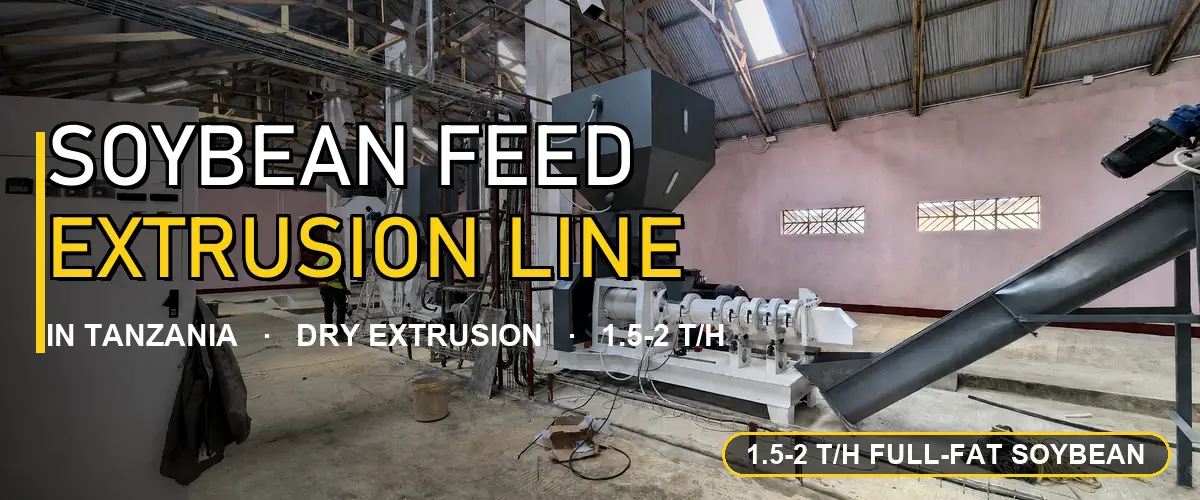
A Tanzanian feed producer now runs a 1.5–2TPH soybean feed extrusion production line supplied by GEMCO. The dry-method line turns whole soybeans into full-fat extruded soybean — a protein- and energy-rich feed ingredient — through cleaning, grinding, extrusion, and cooling. This project case explains why the feed mill chose dry extrusion, how the four-machine line was installed in Tanzania, and what the GEMCO commissioning team delivered on site.
Project Overview: Soybean Feed Extrusion Production Line for Tanzania
GEMCO designed, supplied, and commissioned the 1.5–2TPH line for a commercial feed producer in Tanzania in 2025. The line converts locally grown whole soybeans into full-fat extruded soybean meal, giving the mill a stable, home-produced protein source instead of relying on imported ingredients.
- Rated Capacity: 1.5–2 tons per hour of extruded full-fat soybean.
- Feedstock: Whole soybeans sourced locally.
- Core Equipment: Rotary cleaner, hammer mill grinder, dry extruder, and cooler — four machines, one continuous process.
- Extrusion Method: Dry method extrusion, which needs no steam boiler or pre-conditioner, keeping the line simple to install, operate, and maintain.
- Timeline: Equipment arrived at the port in mid-2025; the complete scope — wiring, trial runs, load production, and operator training — was finished within the planned ten-day on-site period in August 2025.
Why the Feed Mill Chose Dry Extrusion for Full-Fat Soybeans

Raw soybeans contain anti-nutritional factors such as trypsin inhibitors, which limit how much unprocessed soybean can be included in poultry and livestock diets. Extrusion cooks the bean at high temperature and pressure, destroying these inhibitors and making the protein and oil more digestible. The result is full-fat extruded soybean: a feed ingredient that delivers both protein and energy in one product.
For a mid-size feed mill, the deciding factor was plant simplicity. A dry extrusion line eliminates the steam boiler, pipes, and water treatment that wet extrusion requires. With only four machines and no boiler room, the line is faster to install, easier for local operators to learn, and cheaper to keep running — practical advantages in markets where skilled maintenance is scarce.
Process Design: Four Simple Steps from Soybean to Full-Fat Meal
The production line runs a continuous flow: whole soybeans are cleaned, ground, extruded, and cooled. Because every stage is a single machine, the line has few moving interfaces, which is exactly why it is easy to install and operate.
| Process Stage | Core Equipment | Function |
|---|---|---|
| Cleaning | Rotary cleaner | Remove oversized impurities and foreign matter |
| Grinding | Hammer mill grinder | Reduce soybeans to uniform powder |
| Extrusion | Dry extruder | Cook at high temperature, destroy anti-nutritional factors |
| Cooling | Cooler | Stabilize product temperature for storage |


- Cleaning: Rotary Cleaner Removes Oversized Impurities
Whole soybeans first pass through a rotary cleaner that removes oversized impurities and foreign matter before grinding. Clean feed protects the grinder screen and keeps the downstream extruder running at a steady load.
- Grinding: Hammer Mill Reduces Soybean to Uniform Powder
The hammer mill grinds cleaned soybeans into a uniform powder. Grinding consistency matters more than it appears: oversized particles pass through the extruder machine only partially cooked, while powder that is too fine can overload the machine. During commissioning, the screen size was adjusted on site so the grinder output matched the extruder’s cooking capacity.
- Extrusion: Dry Cooking That Destroys Anti-Nutritional Factors
The dry extruder is the heart of the line. Friction and pressure raise the material temperature rapidly, cooking the soybean meal and inactivating trypsin inhibitors and other anti-nutritional factors without added steam. The screw and sleeve assembly is the main wear component; operators are trained to dismantle, inspect, and reassemble it as routine maintenance.
- Cooling: Stable, Storable Full-Fat Soybean
Hot extruded meal leaves the machine at high temperature and must be cooled before bagging or storage. The cooler brings the product to a stable temperature and moisture level, preventing condensation, caking, and quality loss in the warehouse.
Installation and Commissioning in Tanzania


The GEMCO commissioning team arrived on site in August 2025 and started by reviewing the customer’s own installation work. Wiring was completed and every machine was oiled and leveled. During the no-load trial run, the team found that the extruder tripped the customer’s power protection when starting — the inrush current exceeded the existing circuit rating. The customer upgraded the supply line, after which the motor started reliably.
- No-Load Trial Run: All machines ran empty to verify rotation direction and mechanical stability; vibration dampers were fitted under the grinder.
- Load Production Test: With the power issue solved, the extruder produced full-fat soybean meal successfully on the first full load attempt.
- Line Adjustment: A clogging issue traced to the grinder screen was resolved by matching screen size to the extruder’s throughput; the screw assembly was fine-tuned to eliminate partially processed beans in the output.
- Continuous Production: The line ran continuous batches — 2 tons, then 5 tons — confirming the rated 1.5–2TPH capacity under real operating conditions.
Get a Free Soybean Extrusion Line Layout
Operator Training and Handover
Training was scheduled in parallel with production rather than as an afterthought. The GEMCO team trained the customer’s operators in three stages: screw and sleeve assembly of the extruder, the full production flow, and routine maintenance. On the final day, the customer’s own workers ran the line independently while the commissioning team supervised — the standard handover test that shows the line no longer depends on the supplier’s presence.
Results: Full-Fat Soybean Production Up and Running
- Local Raw Material, Higher Margin: The mill now converts local soybeans into a premium feed ingredient, reducing reliance on imported protein sources.
- Simple Operations: Four machines, no boiler, and a short learning curve mean the line can be operated by a small crew.
- Verified Capacity: Continuous production runs confirmed stable output at the 1.5–2TPH design rate.
- Maintenance-Ready Team: Local operators can dismantle and reassemble the extruder screw assembly and perform routine maintenance without external support.

The project demonstrates the core value of dry extrusion for feed mills in developing markets: full-fat soybean production with equipment that is inexpensive to run and easy to keep running.
Request a Capacity and Power Estimate
Why GEMCO for Soybean Extrusion Projects
GEMCO designs, manufactures, and commissions soybean extrusion lines and other feed processing equipment, with the same engineering team covering process design, installation, and operator training.
- Process-First Engineering: Line layouts are matched to the customer’s raw material, capacity target, and local conditions — not copied from a standard drawing.
- Simple, Robust Machines: Dry extrusion keeps the line free of boilers and complex auxiliary systems, which directly lowers installation cost and maintenance workload.
- On-Site Commissioning: GEMCO engineers supervise installation, run trial production, and train operators until the customer’s team can run the line independently.
- After-Sales Support: Remote diagnostics and spare parts keep the line running long after handover.
FAQ: Soybean Feed Extrusion Production Line Questions
- What is a soybean feed extrusion production line used for?
- It processes whole soybeans into full-fat extruded soybean for animal feed. Extrusion cooks the beans, destroys anti-nutritional factors, and produces a protein- and energy-rich ingredient that can be included in poultry, pig, and cattle diets.
- What is the difference between dry and wet extrusion?
- Dry extrusion uses friction and pressure inside the machine to cook the material and needs no steam boiler or pre-conditioner. Wet extrusion requires steam supply and more auxiliary equipment. Dry extrusion is simpler to install and operate, which suits most mid-size feed mills.
- Why extrude soybeans before feeding them to animals?
- Raw soybeans contain trypsin inhibitors and other anti-nutritional factors that reduce digestion and can harm animal performance. Extrusion inactivates these compounds, so the feed’s protein and oil are fully available to the animal.
- What capacity does this line offer?
- The line is rated at 1.5–2 tons per hour of full-fat extruded soybean, verified during continuous production runs at the customer’s site.
- Can the line process other oilseeds?
- With adjusted machine settings, the same dry extrusion principle applies to similar oilseeds and legumes. GEMCO engineers confirm the configuration for each feedstock before quotation.
Get a Custom Quote for Your Soybean Feed Extrusion Production Line
Every feed mill has different raw material, capacity, and site conditions. GEMCO engineers tailor the soybean feed extrusion production line to your requirements — from machine selection to layout and training. Send us your target capacity and feedstock to receive a process design and quotation.