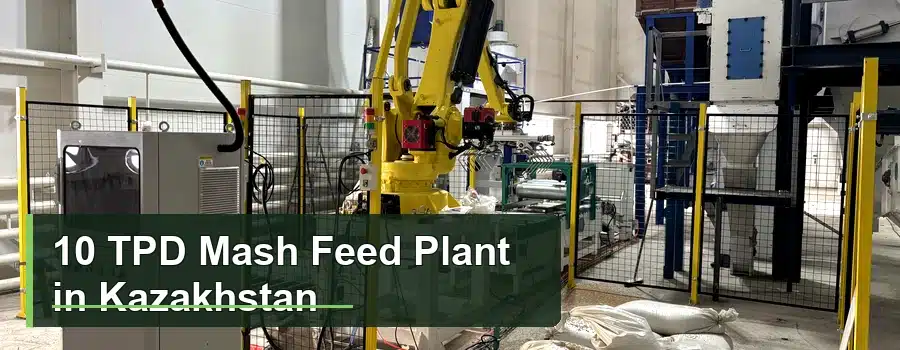
A 10 TPD automatic batching mash feed plant was delivered and commissioned for a feed processing company in Kazakhstan, with installation supervision from 1 to 6 November 2025 and a second phase for commissioning and training starting in January 2026. The plant grinds, batches, mixes and bags wheat-based mash feed on four indoor steel platforms up to 14 m high, using 41 equipment items and 278.2 kW of installed machinery power.
| Feature | Detail |
|---|---|
| Project type | Automatic batching mash (powder) feed plant |
| Location | Kazakhstan |
| Capacity and raw material | 10 TPD mash feed output; wheat as the main ingredient with barley in the mix |
| Key equipment | Hammer mill with 1.2 mm screen; rotary grading sieve; two 8 m³ batching bins; 1 t scale; ribbon mixer; MCC with recipe management |
| Installed power | 278.2 kW across 41 equipment items |
| Plant layout | Indoor steel structure with platforms at 2.6 m, 7.0 m, 9.2 m and 14 m |
| Programme | Installation supervision 1 – 6 November 2025; commissioning and training from January 2026 |
Project Overview: 10 TPD Automatic Batching Mash Feed Plant in Kazakhstan
The client is a feed processing company in Kazakhstan that added a mash feed line for its local market; the scope stops at packed bags, with no pelletizing, cooling or crumbling stage.
Scope of Supply for the Mash Feed Plant
The supply covers four equipment groups plus the electrical package: intake and conveying, grinding and screening, batching and mixing, and finished-product handling. Non-standard steelwork — frames, material pipes, platforms, stairs and handrails — is supplied by the customer, along with the main cable from the switch room to the MCC. The scope is narrower than a complete feed mill plant, since the finished-product bins, the customer elevator and the packing machine were already on site. A mash line omits the pelletizing circuit; a pig feed pellet line in Indonesia adds a pellet mill, cooler and crumbler to the same front end.
Raw Material and Site Conditions in Kazakhstan
Wheat is the main raw material, with barley held on site for the normal production mix. Because mash feed is only ground, weighed and mixed, incoming grain quality decides most of the final product quality — no pelleting step masks variation in grind or dosage. Winter is a constraint: the outdoor silo could not be fed until the weather warmed.

How the Automatic Batching Mash Feed Plant Works

The line is a gravity-fed tower: material is lifted to the top, then falls through grinding, screening, batching and mixing before being raised once more to the finished-product bins.
Intake Section: Elevator, Scraper Conveyor and Magnetic Separation

Material is dumped at the intake hopper, lifted by bucket elevator and moved by scraper conveyor to the magnetic tube ahead of the pre-grinding bin. The magnetic tube removes tramp iron at a rated 99% removal rate, protecting the mill screen from metal that would punch through it. Separation earns its place here: stones and metal in the local wheat caused screen damage during the trial.
Grinding Section: Hammer Mill and Rotary Sieve Circuit

The hammer mill runs a 1.2 mm screen — a 14-mesh opening — and is fed by a variable-speed impeller feeder matched to mill load. Output is lifted to a rotary grading sieve where oversize returns for a second pass. Uneven feeding was the largest cause of current fluctuation on this poultry feed grinder machine.
Batching and Mixing Section: Bins, Weighing Scale and Ribbon Mixer

Screened material is lifted into two 8 m³ batching bins, with a small stainless bin for additives. Each bin discharges through a screw conveyor with variable-pitch flight for a steady flow as the batch approaches its target weight. The 1 t scale holds a static accuracy of 1‰ or better and a dynamic accuracy of 3‰ or better. Mixing runs in a single-shaft ribbon mixer rated at 97.7% mixing uniformity. Additives are weighed by hand, so the animal feed mixer machine never sees an unweighed ingredient.
Bagging and Palletizing Section
The batch is released into a buffer hopper, conveyed to the third bucket elevator and raised into the finished-product bins, which feed the customer’s existing packing machine filling 50 kg bags; the palletizer stacks them at the end of the line. Every bin holding fine mash carries a vibrator to prevent bridging, and the level indicator in the packing machine’s top hopper must leave headroom for the elevator to run empty before shutdown.
Control System and Recipe Management
The MCC is a central panel with a mimic display, feeding motors from 22 kW to 55 kW through star-delta starters and carrying automatic batching with a touch screen and recipe management. An authorised operator calls up a stored recipe and sets component weights and mixing time; the programme runs the batch automatically. The feed production line starts from the last machine forward and stops from the first machine forward, so no conveyor is left carrying a load.


Main Equipment and Technical Parameters
| Section | Equipment | Key Specification |
|---|---|---|
| Intake | Elevator, scraper conveyor, magnetic tube | Pneumatic three-way valve; 99% iron removal rate |
| Grinding | Hammer mill and dust control | 1.2 mm screen (14 mesh); settling chamber and pulse collector |
| Screening | Rotary grading sieve | Oversize returned to the mill for a second pass |
| Batching and mixing | Bins, scale and ribbon mixer | Two 8 m³ bins; 1 t scale, static 1‰, dynamic 3‰; 97.7% mixing uniformity |
| Electrical | MCC with automatic batching | Star-delta starting 22–55 kW; PLC batching with recipe management |
Mash Feed Mill Installation Record: Four Platforms up to 14 m
The programme ran in two visits: the first covered installation supervision and equipment positioning, the second covered wiring, power-on testing, the feed trial, fault correction and training.
Steel Structure and Platform Levels
Each level carries a defined equipment set: the 2.6 m platform holds the hammer mill, air-box screw, pulse filter and mixer; the 7.0 m platform holds the batching scale and bins; the 9.2 m platform holds the bin group and rotary sieve; the 14 m level holds the elevator heads. Steel first, then heavy machines from the bottom platform upward, then spouting and guards.
Positioning, Piping and Connection Details
Supervision opened with a full check of the delivered equipment and the customer’s steelwork. The remaining work was detail work: connection angles between machines, flexible connections at hopper inlets and outlets, and spouting alignment.


Wiring, Weak-Current Loops and Air Lines

Power wiring was completed in the second visit along with the weak-current loops for weighing sensors, solenoid valves, air hammers, level indicators and door interlocks, plus the air lines driving the pneumatic gates. The remaining closures — micro-batching screw direction, flexible connections, hatch seals and level indicators — were completed by the customer’s team against the transferred list.
Feed Trial: 8 t of Wheat Through the Line
The trial ran on about 8 t of wheat from the outdoor silo, put through the full circuit. Wheat was the only material used because the additives had not arrived; the finished bags were returned to the mixing bin and reused.


Customer Feedback
The customer recorded no failures or breakdowns during installation and commissioning. Every service and delivery item was rated very satisfactory: removal of any failures, equipment arrangement on site, convenience of operation and maintenance, service orientation, delivery timeliness and completeness, after-sales timeliness, the user manual, on-site installation and commissioning, supervisor efficiency, and construction progress.


Open Items, Training and Follow-Up
Training was delivered in three recorded sessions: start-up and shutdown with material flow on 25 and 26 January; handover of training materials on 28 January; and palletizer operation from 29 January into early February. Open items — micro-batching screw direction, flexible connections, hatch seals, level indicators, air hammers, dust pulse valves and palletizer positioning — were handed to the customer’s team for completion against the transferred list. The handover sheet records no spare parts requirement and no expansion plan, and lists the outstanding documentation need as the electrical drawings and operation materials.
Four-Platform Layout and Vertical Material Flow in a Mash Feed Plant
The tower arrangement is not a footprint compromise but the cheapest conveying system available: with each stage above the next, gravity carries material between grinding, batching and mixing, and the plant needs three elevator lifts instead of a train of horizontal conveyors.
Platform Levels: Equipment Zoning from 2.6 m to 14 m
The levels are zoned by function. Grinding, dust collection and mixing sit on the 2.6 m platform, which keeps the largest vibration and dust sources at the lowest level; batching and the weighing scale occupy the 7.0 m platform directly above the mixer, so a weighed batch drops without an intermediate transfer; bin storage and the rotary grading sieve occupy the 9.2 m platform; and every elevator discharges at the 14 m head. Only bins, hoppers and conveyors sit above the mill.
Gravity and Vertical Material Flow Between Stages
Material is raised once to the 14 m elevator head and then falls through the grinding circuit to the 7.0 m batching level, where the scale discharges straight into the mixer below. One final lift returns the mixed batch to the finished-product bins, and from there it is gravity again down to the bagging scale. Every extra lift adds a bottleneck and a maintenance point, which is why a feed processing flow design that follows the building’s vertical layout holds fewer transfer points than one drawn as a horizontal train.
Supply and Construction Split in a Mash Feed Plant
The split between buyer and supplier is settled item by item before shipment, because it decides which team mobilises first. We supply the process equipment, the dust control, the MCC and the batching system; the customer supplies the steelwork — frames, material pipes, platforms, stairs and handrails — the main cable to the MCC, and lifting and transport on site. A commercial animal feed processing plant is divided the same way, and steel is cheaper to fabricate locally than to ship. Where pelleting is added later, a feed pellet mill becomes the largest single addition, and this front end stays as it is.


- What capacity does this mash feed plant in Kazakhstan run at?
- The line is designed for 10 TPD of mash feed output, across 41 equipment items with 278.2 kW of installed power, using wheat as the main raw material.
- What is the difference between a mash feed plant and a pellet feed plant?
- A mash feed plant stops at grinding, batching, mixing and bagging, so it needs no steam, pellet mill or cooler and has lower capital cost and connected load. A pellet line adds those stages.
- How accurate is an automatic batching system in a feed plant?
- The scale is built to a static accuracy of 1‰ or better and a dynamic accuracy of 3‰ or better, and the ribbon mixer is rated at 97.7% mixing uniformity. Recipes run automatically.
- Why did the hammer mill current fluctuate during the feed trial?
- Uneven feeding. At a feeder drive setting of 5–7 Hz the mill current swung widely; once the feed rate was evened out the drive ran at 14 Hz with a stable current.
- What screen size should be used for grinding feed ingredients?
- This line runs a 1.2 mm screen, or 14 mesh. To check the grind, sieve the product: material retained on the mesh means it is coarser than the screen implies.
- How long does installation and commissioning take for a 10 TPD feed line?
- Installation supervision took six days on site with a two-person team from 1 to 6 November 2025, and the commissioning and training phase began in January 2026 and ran through the trial, fault correction and three training sessions.
- Why do weighing load cells fail in a feed plant?
- Welding next to an installed batching scale passed current through the transducer and damaged it, showing up as a several-kilogram error. Install transducers only after welding in that area is complete.