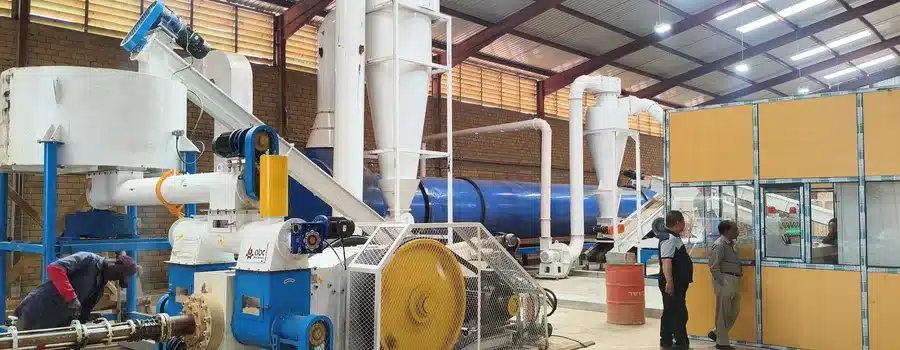
A 5 T/D sawdust briquette charcoal making machine was delivered, installed and commissioned for a charcoal briquette manufacturer in Ethiopia, with the first on-site programme running from 23 July to 20 August 2025 and a second commissioning and training phase from 16 to 30 September 2025. The line accepts over 15 t/day of sawdust, wood chips and coffee husk and produces 5 t/day of charcoal briquettes at 324.7 kW on a 400 V, 50 Hz three-phase supply stepped down from 33 kV. This report gives the equipment configuration, the commissioning record, and the field problems and their resolutions.
| Feature | Detail |
|---|---|
| Project type | Turnkey carbonization and charcoal briquetting line |
| Location | Ethiopia |
| Design capacity | Over 15 t/day input, 5 t/day charcoal briquette output |
| Raw materials | Sawdust and wood chips, plus coffee husk |
| Core process | Drying, pelletizing, carbonization, cooling, crushing, binder mixing, briquetting, mesh belt drying, packing |
| Key equipment | Φ1200 × 11500 mm drum dryer; Φ1200 × 10500 mm carbonization machine; Φ1500 × 4000 mm pyrolysis chamber; BSYQ-290 press |
| Installed power | 324.7 kW total; 400 V, 50 Hz, three-phase; 33 kV to 400 V transformer supplied |
| Emission control | Spray tower, condensers, activated carbon adsorption |
| Programme | 7 × 40′ HQ containers; 30 working days on site (23 July – 20 August 2025); second phase 16 – 30 September 2025 |
Project Overview: 5 T/D Sawdust Briquette Charcoal Making Machine in Ethiopia
The plant is run by a charcoal briquette manufacturer locally. Sawdust and wood chips are available in volume and coffee husk is a second low-cost feedstock, which made the project viable.
Delivery Scope of the Sawdust Briquette Charcoal Making Machine
The supply covers 41 equipment items across drying, pelletizing, carbonization with waste gas treatment, and briquetting, plus a site transformer. Motor ratings run from a 2.2 kW screw conveyor to the 90 kW pellet mill and the 22 kW exhaust fan, for 324.7 kW installed, configured for 24-hour operation with maintenance every 15 days. The line shipped in 7 × 40′ HQ containers with a twelve-month warranty.
Raw Material and Power Supply Conditions
Sawdust and wood chips are the primary feedstock with coffee husk secondary; all three carbonize but differ in bulk density and moisture release rate. The site holds roughly one year of raw material, so all production risk sits on drying. The rainy season runs six months above 40% humidity, and the incoming 33 kV supply is stepped down to 400 V, 50 Hz three-phase; grid voltage proved unstable.
How the Sawdust Briquette Charcoal Making Machine Works
The process is a closed loop: material is dried, pelletized into a uniform feed, carbonized, cooled, crushed to charcoal powder, mixed with binder, pressed into briquettes, dried on a mesh belt and packed. Gas released during carbonization is recovered and burned back into the system.
Drying Section: Φ1200 × 11500 mm Drum Dryer and Belt Feeding

Material enters on a B650 × 14000 mm incline belt conveyor at 5.5 kW with a BWD4-23 reducer and variable-frequency control. Drying happens in a rotary drum dryer of Φ1200 × 11500 mm in Q235 with a 10 mm shell and deflector plus lifting plates, turned by a ZQ350 reducer at 48.57 ratio and 7.5 kW, with dust going to a Φ1500 × 4500 mm cyclone collector and a 15 kW fan.
Carbonization Section: Φ1200 × 10500 mm Carbonization Machine

The main body is Q245R boiler steel at Φ1200 × 10500 mm with a 12 mm shell, turned by a ZQ500 reducer at 48.57 ratio and 15 kW, inside an 1800 × 6000 mm insulation chamber lined with zircon modules and monitored by three K-type thermocouples and a drum pressure transmitter. Feed runs through a Φ200 × 8000 mm screw conveyor into a Φ1500 × 4000 mm pyrolysis chamber with high-alumina refractory lining; the drum runs at 500–650 °C and feed starts only above 150–200 °C inner cylinder temperature, the usual cause of under-carbonized output on this type of carbonization equipment.
Cooling and Charcoal Powder Discharge System

Four cooling discharge screw conveyors of Φ325 × 5000 mm at 3 kW each carry hot char away from the drum, and two Φ1500 × 3000 mm condensers at 3 kW each handle the vapour side. Charcoal powder at discharge temperature oxidises and can ignite, so this is a safety circuit: if circulating water exceeds 60 °C, the tank must be replaced or topped up.
Flue Gas and Tail Gas Treatment System

The purification system is 304 stainless steel at 2000 × 1800 × 600 mm, with a 7.5 kW combustible gas fan drawing gas off the drum and two 15 kW waste heat fans heating the drying circuit. The tail has a Φ1500 × 4500 mm spray tower, two activated carbon adsorption units at 3.3 × 1.4 × 1.1 m and a 22 kW exhaust fan. Diesel only brings the line to temperature; after that process gas supplies the heat, and two-stage filtration lets a plant like this run inside a city boundary.
Briquetting Section: Hammer Mill, Binder Mixing and BSYQ-290 Press


Charcoal passes a hammer mill rated 400–600 kg/h at 11 kW and a Φ1000 mm binder mixing tank at 3 kW, is blended in an S110 wheel mixer at 5.5 kW and formed in a BSYQ-290 press at 5.5 kW. The control point is the binder, not the press: the baseline mix is clay to water at 1:5, with more water for dry powder and more clay when strength is low.
Mesh Belt Drying and Packing of Charcoal Briquettes


Pressed briquettes travel into a three-layer mesh belt dryer with 11 m of belt length, a 6 kW drive and a 15 kW fan, where residence time is 2–3 hours. Heat comes from a biomass and coal combustion chamber, so the plant burns its own waste wood, with a 400,000 calorie gas furnace as backup. Exhaust passes through rock wool then activated carbon before packing.
Main Equipment and Technical Parameters of the Line
| Section | Equipment | Key Specification | Power |
|---|---|---|---|
| Drying | Drum dryer | Φ1200 × 11500 mm, Q235, 10 mm shell | 7.5 kW |
| Pelletizing | Pellet mill | VPM 510, 1.5–1.7 t/h | 90 kW |
| Carbonization | Carbonization machine | Φ1200 × 10500 mm, Q245R, 12 mm shell | 15 kW |
| Carbonization | Pyrolysis chamber | Φ1500 × 4000 mm, high-alumina refractory lining | — |
| Briquetting | Hammer mill and press | 400–600 kg/h mill; BSYQ-290 press | 11 and 5.5 kW |
| Briquetting | Mesh belt dryer | Three layers, 11 m belt length, 2–3 h residence time | 6 kW |
Installation and Commissioning Record from Addis Ababa
On-site work ran in two phases: 23 July to 20 August 2025 across 30 recorded working days for positioning, assembly, piping, electrical connection and a first material trial, then 16 to 30 September 2025 for fault repair, re-commissioning, retraining and handover.


Material Moisture Test and the Decision to Bypass Pelletizing
Material was trialled at 16%, 20%, 25%, 35%, 40% and 50% moisture and pellets formed at every level, so output set the boundary: on 16% sawdust the mill produced 75 kg in 37 minutes against a rated 1.5–1.7 t/h. Fines and moisture varied too widely for the die to run at design rate, so the customer decided to feed dried sawdust straight into carbonization.
Five Field Problems Solved on the Carbonization Line

- Leaking Condenser and Cooling Water PipesPipe routing did not follow the drawing; the route was re-marked and re-welded, then pump-tested leak-free.
- Repeated Blocking of the Pellet MillRaw material fineness and moisture sat outside the pelletizing window, so the route was shortened to direct carbonization.
Operator Training and Handover to the Ethiopian Team


Six sessions were recorded between 18 and 30 September 2025, covering pre-start checks and the start-up sequence of the PLC-controlled carbonization system, fan power adjustment against thermometer readings, the start and stop sequence for the silo auger, hammer mill, wheel mill, briquette press and mesh belt dryer, maintenance points, and clearing after a blockage. Both the plant’s electrician and its production technician reached the point of running the line themselves.
Follow-Up Requirements and the Next Carbonization Line
The customer asked for one large and one small burner plus solenoid valves, oil pump, oil lines and nozzles, and for a detailed operating guide, and plans a second carbonization line within about a year.
Why Material Preparation Sets the Output of a Sawdust Briquette Charcoal Making Machine
Production constraints have never been due to problems with the carbonization equipment itself: every problem traced back to how wet the material was, how consistent its particle size was, and how the binder was mixed.
Sawdust, Wood Chip and Coffee Husk Supply in Ethiopia
Ethiopia’s wood processing and coffee sectors generate a continuous supply of sawdust, wood chips and coffee husk, so a 5 t/day project is viable without importing material. Coffee husk releases moisture faster than dense wood chips, so a mixed feed gives a more even dryer load. Material here arrived with fines and oversize pieces together, so screening before the dryer plus a magnetic separator ahead of the mill are low-cost protections. A comparable charcoal briquette project in Ethiopia applies the same principle.
Rainy Season Moisture and Drying Capacity Sizing
Six months of the year in Addis Ababa run above 40% humidity and on-site material measured at 40% and 50%, so solar drying cannot be part of the process and the drum dryer is the only moisture-control stage. The sizing rule is to work from the lowest moisture carbonization accepts — around 16% — not the annual average. A dryer short of capacity reduces carbonization output and puts wet feed into a drum already at temperature.
Binder Ratio and Briquette Strength Control
The baseline is clay to water at 1:5, with more water for dry powder and more clay when strength is low. Under-dried briquettes are usually a residence-time problem rather than a heat problem, so reducing dryer frequency from 50 Hz to 40 or 30 Hz extends the 2–3 hour drying time. Where a buyer compares press designs, a biomass briquette machine comparison is worth running against the binder chemistry, because the press that forms the best briquette depends on how the mix behaves.
About the Supplier: GEMCO Sawdust Charcoal Making Machine Capability
We deliver turnkey carbonization and briquetting lines to processors worldwide. Our service covers the full chain from raw-material testing and line design through manufacturing, sea freight, overseas installation and commissioning, and operator training. After handover we supply spare parts, wear components and remote technical support.
Frequently Asked Questions
- How much sawdust does a 5 T/D sawdust briquette charcoal making machine process per day?
- Over 15 t/day of input against 5 t/day of output, roughly three to one by weight. The ratio moves with incoming moisture, since wetter feed means more of the input is water.
- What raw material moisture is suitable for a charcoal briquette line?
- Material should reach around 16% or below. Where the rainy season keeps humidity above 40% for half the year, the dryer must be sized from that lower bound, because natural drying cannot be relied on.
- What binder ratio is used for pressing charcoal briquettes?
- The baseline is clay to water at 1:5, with more water for dry powder and more clay when strength is low. If briquettes leave the dryer under-dried, frequency is reduced from 50 Hz to 40 or 30 Hz.
- Does a charcoal briquette line in Ethiopia need its own transformer?
- It depends on the incoming supply. This plant is fed at 33 kV and runs on 400 V, 50 Hz three-phase, so a transformer was included. Confirm that available capacity covers the 324.7 kW installed load.
Planning a sawdust briquette charcoal making machine around your own raw material? Send us the material type, its moisture range and your target daily output, and we will return a line layout, equipment list and capacity calculation.