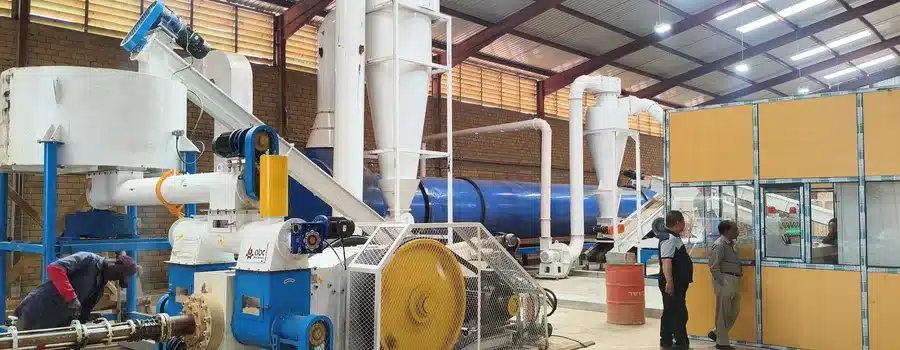
In the context of the booming global biomass pellet industry, businesses face enormous market opportunities and challenges. According to data, the compound annual growth rate (CAGR) of the biomass pellets making machine market has exceeded 7%, and market demand keeps rising. Choosing a suitable flat die pellet machine, especially between the two mainstream driving forms – moving roller and moving die – directly determines the production efficiency, operational stability, and final profitability of a biomass pellet production plant. This article will deeply analyze the advantages, disadvantages, applicable scenarios, and selection mistakes of both flat die pellet mill designs, helping you make scientific purchasing decisions and achieve efficient operation.

Choose Suitable Flat Die Pellet Machine
What Is a Flat Die Pellet Machine
A flat die pellet machine is a biomass pelletizing device using a flat mold where raw materials are compressed through die holes under roller pressure. Compared to the ring die pellet machine, the flat die design is more compact, requires lower investment, and takes up less space, making it ideal for biomass fuel pellets, feed pellets, and organic fertilizer pellets. The key differences between moving roller and moving die designs are as follows:
| Dimension | Moving Roller | Moving Die |
|---|---|---|
| Structure Principle | Roller rotates, die stays still; pressure adjustable, evenly distributed | Die rotates, roller stays still; simpler design, higher speed |
| Typical Pellet Quality | Density ≥1.2 g/cm³, ash 0.5–1.2%, suitable for premium export | Density ≈1.0–1.1 g/cm³, slightly higher ash |
| Production Stability | Lower die wear by 30–40%, steady quality | Uneven wear, size & density fluctuation up to 10–15% |
| Energy Efficiency | Adjustable roller gap reduces unit energy by 10–15% | Needs high speed, actual power consumption higher by 5–8% |
| Raw Material Adaptability | Works well with 8–15% moisture high-fiber material, forming rate ≥90% | Better for powdery, low-moisture (6–10%) single material, forming rate ≈85–90% |
| Maintenance & Lifespan | Die and roller life 20–30% longer, lower long-term cost | Simpler to dismantle, fits small plants or startups |
Due to variations in material types, moisture, fiber content, and capacity demand, choosing the right flat die pellet machine is never “one size fits all.” If a biomass pellet processing plant only relies on biomass pellet machine power or biomass pellet equipment supplier quotes, it may lead to low forming rate, high energy consumption, or accelerated wear in the biomass pellet production line – directly impacting profits and delivery stability. Contact us to get free and professional answers immediately.

How to Build an Efficient Flat Die Pellet Machine Production Line
Many buyers only focus on the single biomass wood pellet machine parameters of a flat die pellet machine (like power, die size, price) but overlook what truly determines production cost and pellet quality: the full biomass pellet line process design. A mature biomass pellet production line isn’t just adding a crusher, dryer, and biomass wood pellet mill together. Instead, it’s about scientific configuration and collaboration in the biomass pellet manufacturing process to improve yield, reduce energy consumption, and maximize ROI.
Raw material moisture 10–15%:
- Studies show raw material size ≤5mm increases forming rate by 10–15% and reduces dust.
- Large biomass pelletizing plant keeping moisture at 10–15% increase pellet density by over 5% and reduce die blockage by 50%.
- GEMCO’s hammer mill and drum dryer ensure consistent particle size and moisture, keeping forming rate above 90%.
High-efficiency pelleting with 6–8mm die
- Daily output depends on die hole size; 6mm and 8mm suit different hardness/specs.
- Adjusting compression ratio raises hardness by 15%, prolonging storage life.
- GEMCO’s auto-lubrication reduces manual work and extends die & roller life by ~20%.
more than 95% of Sieve particles pass rate
- Counter-flow cooling drops temperature from 70–90℃ to 25℃, cutting breakage by 40–60%.
- Qualified pellets (>95%) raise market acceptance and repeat orders by 20%.
- GEMCO uses efficient coolers and vibrating screens to keep shape uniform and customer satisfaction high.
Quantitative accuracy ±1% of packaging & Intelligent
- Automatic packers keep weight precision within ±1%.
- Cloud monitoring systems cut troubleshooting time by over 30%.
- GEMCO offers custom remote monitoring to help biomass pellet plants boost automation and management.

Complete Set of Flat Die Pellet roduction Line for Sale
Why Choose GEMCO Flat Die Pellet Machine
As renewable energy gains popularity, more biomass pellet manufacturing plants want not only to produce but to lower biomass pellet plant operating costs, improve forming rates, and achieve smarter management. Choosing GEMCO means you get:
| Pre-sales | demand research ,selection plan,sample test |
|---|---|
| Sales | Installation guidance,operator training,local engineers |
| After-sales | smart diagnostics ,fast spare parts,long-term support |

Choose Best Biomass Pellet Making Manufacture to Start Your Business
With years of experience, GEMCO delivers biomass wood pelleting machine solutions that achieve maximum capacity and lowest energy use. Our team optimizes processes from raw material to final product.Whether you’re buying your first biomass pellet making machine or upgrading your line, GEMCO engineers are always ready to help free of charge. Trust GEMCO for safer investment, higher productivity, and steady profits. Contact us now for a custom solution!