Making Leather Waste Pellet in RDF Plant
Leather Waste Characteristics and RDF Compatibility
Leather waste, predominantly sourced from tanneries and footwear manufacturing, contains chrome-tanned shavings, leather trims, and offcuts. These materials are rich in organic content and show promising energy yields for RDF raw materials, with typical calorific values ranging from 18 to 24 MJ/kg.
However, concerns arise from chemical additives such as chromium compounds and tanning residues. Moisture content varies between 20~35%, necessitating drying before processing. When blended with low-contaminant RDF sources like wood chips or textile waste, leather enhances burn uniformity and energy density.
Comparative trials demonstrate that blending 20~30% leather waste with biomass-based RDF boosts fuel compactness by 15% and reduces fly ash dispersion.
Optimize RDF blends with high-energy leather waste pellets — contact us to design your material compatibility matrix.
Engineering Methods for High-Density RDF Pellet Formation
- Pre-Processing Requirements
Leather scraps are first shredded to under 20 mm particle size and dried to ≤12% moisture using rotary or belt dryers with 1.5~2.8 t/h capacity. Inline moisture sensors ensure real-time adjustment during drying.
- Pressure and Temperature Parameters
Pelletizing requires setting compaction pressure between 180 and 260 bar and controlling die temperature from 85°C to 115°C. These settings help achieve a target bulk density of 600~720 kg/m³.
- Binder Selection and Strength Optimization
Leather fibers require strong cohesion, achieved using binders like lignosulfonate (2~3%) or polymer additives. Pellet crush resistance must exceed 80 N to ensure integrity during handling and combustion.

RDF Leather Pellet Production Flow Chart
Pellet Formation Process Flow
| Step | Process Detail |
|---|---|
| 1 | Shredding to 10~20 mm |
| 2 | Moisture reduction to <12% |
| 3 | Binder mixing (2~4% by weight) |
| 4 | Die compression at 200~250 bar |
| 5 | Cooling and sieving |
Technology Notes
- Equipment: Twin-screw extrusion or ring-die pelletizers preferred for leather’s elastic structure.
- Forming Precision: Consistent feed rate control reduces pressure fluctuation, maintaining pellet uniformity.
- Energy Efficiency: Specific energy consumption should remain under 180 kWh per ton of pellets.
Implementing precise thermal and mechanical controls ensures the formation of robust, high-density RDF leather pellets with uniform combustion characteristics.
Get a customized RDF pelletizing engineering package tailored for leather waste — Talk to our process specialists now.

Combustion Performance and Emission Control of Leather RDF Pellets
Leather RDF pellets exhibit slow ignition but prolonged combustion phases, releasing energy steadily. Tests indicate emissions of 1.2~1.8 kg NO₂ and 0.8~1.5 g/m² chromium particulates per ton of leather burned.
Emission control begins at the material selection phase. Using only chrome-free leather waste or neutralizing agents during pelletizing (e.g., calcium carbonate) reduces Cr(VI) release by over 65%.
Gas scrubbing and particulate filtration systems such as baghouse filters or ESPs (electrostatic precipitators) are essential to meet EU RDF flue gas norms.
Combustion trials show leather RDF pellets reaching thermal efficiencies of 82~87% in fluidized bed and rotary kiln systems when paired with appropriate air staging and post-treatment equipment.
Ensure compliance with emission regulations while utilizing leather RDF fuels—ask our experts for emission mitigation design plans.

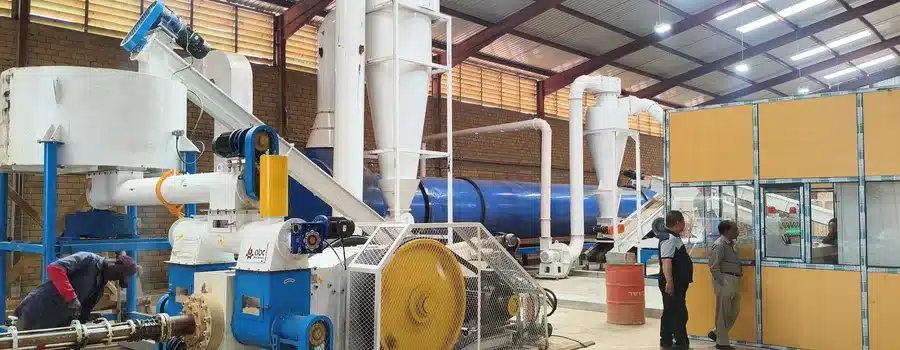
Leather Pellet Machine in RDF Production Plant
Industrial Use Cases of Leather-Based RDF Pellets
Industrial facilities in sectors like textile dyeing, cement production, and combined heat and power (CHP) plants are leveraging leather waste pellets to replace 10~20% of fossil fuel inputs.
In one European case, a 12 MW boiler line used 2,400 tons/year of leather RDF, reducing CO₂ output by 4,800 tons. With a consistent calorific value of 22 MJ/kg and ash content under 10%, leather pellets offer both thermal performance and manageable by-products.
Operational data show fuel savings of $30~$45 per ton, despite minor challenges such as odor and ash treatment. Adopting leather RDF requires equipment calibration and operator training but results in notable cost and emission advantages.
By transforming leather scrap into leather waste pellets, industries can optimize RDF Raw Materials strategy with high-energy, dense fuel that supports sustainable and compliant combustion.