Drying Technique in RDF Production Process
The Role of Drying in the RDF Production Process
Drying is a critical phase in the RDF production process, primarily aimed at reducing moisture content and improving the fuel’s calorific value. Moisture levels in raw waste can reach up to 50%, significantly reducing energy density. Proper drying can lower this to below 15%, increasing RDF heating value from 11 MJ/kg to over 18 MJ/kg.
Positioned after shredding and before pelletizing or baling, the drying stage prepares feedstock for compacting and combustion. Consistent dryness ensures uniform densification and prevents steam generation during combustion, which otherwise reduces thermal efficiency.
In RDF systems, stable drying operations improve energy recovery rates and reduce emissions by controlling residual moisture.

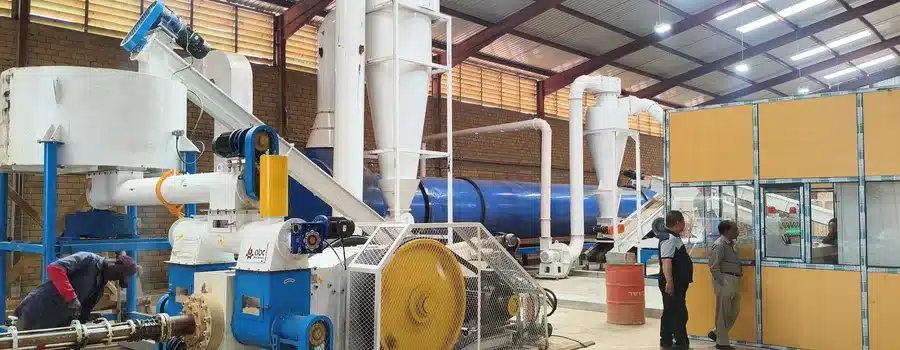
RDF Equipment Running in Action
Reach out to our team to integrate energy-optimized drying into your RDF workflow.

Common RDF Drying Technologies and Equipment
Rotary Drum Dryers
Rotary dryers are widely used for high-moisture RDF. These systems utilize rotating drums heated by steam or hot gas. Typical throughput ranges from 5 to 25 tons/hour with outlet moisture as low as 10%. Heat exchange efficiency is around 60–70%. Models with triple-pass drum design further enhance energy transfer and reduce space requirements.
Belt Dryers
Belt dryers are effective for temperature-sensitive RDF components. With gentle, laminar hot air flow, they process 3–20 tons/hour. Modular belt systems enable segmented drying zones with real-time moisture adjustment. They offer energy efficiency up to 75%, ideal for mixed plastic-paper RDF.
Flash Dryers
Flash dryers operate at high air velocities, suitable for RDF with fine, light particles. They dry up to 5–12 tons/hour with short retention time and rapid moisture drop. However, they are less suitable for heavy or fibrous waste. Their thermal efficiency is often above 70% when integrated with heat recovery systems.
Automated Moisture & Temperature Control
Modern drying systems integrate real-time sensors, PLCs, and thermal feedback loops. These enable precise temperature zoning (±2°C) and outlet moisture regulation (±1%). Automated control can improve line stability and reduce energy overuse by 15–20%.
Comparison Table: RDF Drying Technologies
| Dryer Type | Capacity (T/H) | Best For | Efficiency |
|---|---|---|---|
| Rotary Drum | 5–25 | High-moisture RDF | 60–70% |
| Belt Dryer | 3–20 | Mixed feedstock with plastics | 65–75% |
| Flash Dryer | 5–12 | Fine RDF particles | 70–80% |
- Rotary Dryers: Robust and scalable for bulk RDF.
- Belt Dryers: Flexible for varied material sensitivities.
- Flash Dryers: Efficient for lightweight and powdered RDF.
Selecting the right drying system is critical to RDF fuel consistency, safety, and throughput. Get Expert Help to Integrate the Right Dryer for Your RDF Plant Today!
Managing Drying Parameters to Enhance Stability and Efficiency
Efficient RDF drying requires tight control over RDF drying parameters, including airflow, temperature, and feed rate. Inconsistent inputs can lead to under- or over-drying, compromising fuel performance.
Moisture Control Tactics
- Use NIR sensors and in-line infrared detectors for moisture tracking.
- Adjust drying speed based on initial feed moisture (±5%) to target final moisture of 10–15%.
- Implement staged heating zones for uniform drying.
Drying Curve Calibration
Each RDF feedstock has a unique drying curve. Urban waste with high organics dries slower than sorted industrial RDF. Curve data ensures equipment runs at peak efficiency—avoiding energy waste and processing delays.
Failure to manage drying consistency can lead to costly system overloads, RDF quality fluctuation, and downstream blockages.
Unlock drying stability and optimize RDF fuel with intelligent process control systems—Contact Us Now
Energy and Economic Analysis of RDF Drying Operations

Showcase of RDF Plant Construction Project
Drying accounts for up to 30–40% of total RDF production process energy use. Energy source selection—steam, electricity, or hot air—directly impacts cost and system sustainability.
Thermal Source Comparison
- Steam-based systems: Stable, widely available; operating cost ≈ $8–12/ton RDF dried.
- Electric dryers: Higher precision; costlier at ≈ $10–15/ton.
- Hot air burners: Fast response; best for integrated CHP systems; ≈ $7–11/ton.
Energy-saving features like heat exchangers and condensate recovery can reduce net energy use by 15–25%.
Integrating drying with waste heat recovery from incinerators or gasifiers further reduces external energy demand.
Improve drying ROI with strategic energy sourcing and advanced control technologies—Talk to Our Experts